

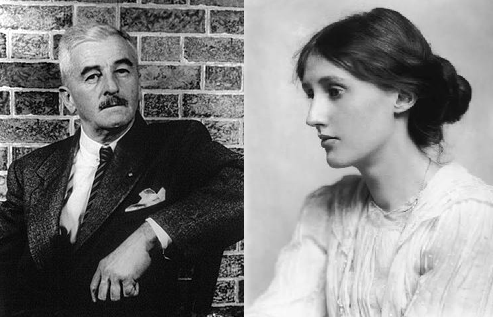
Two literary marshals of past and present, showing how the multitude of people in our lives shapes our understanding of modernity
A responsible reader is nowhere to be found. Our age values impatience, turning reading into something reductive and performative, something to skim through in passing. We are like children in a playground, dipping our toes into this new shiny thing but no more, for ‘more excitement awaits, oh I must not lose a moment!’ Our sole body of opinions is composed of things overheard, simplified, as it were, ‘gisted’, so that we were to remain by an opinion, for it is scary not to have one. But authors like Woolf and Faulkner were not writing for us. They were writing for this underground dozen that wasn’t intimidated by a book. Let us aspire to be that dozen, for, arguably, there is still a lot to learn from them.
Virginia Woolf was indeed a remarkable figure. Born Adeline Virginia Stephen in 1882, in South Kensington, London, she lived most of her life between London and Sussex, in a remarkably volatile literary milieu. Leaving behind the Victorian (Dickens, Eliot) and the Edwardian (Wells) the new generation needed to make a radical shift. Literature sought redefinition. At this intellectual fair, Woolf was far from a bypassing literati. As a matter of fact, being one of the members of the influential Bloomsbury Group, she too felt acutely the common cause of literature that many of her contemporaries propounded—writing as a self-justifying action. Its subject, they argued, must be human interiority. Woolf, too, wanted to break away from the canon (Freuds and Joyces can make you radical). Instead of having a thing to steer the book towards, she turned inwards.
A mathematical problem: a mind is an eddy, and any attempt to interpret it meaningfully has always been a challenge. Except for this certainty, that it is an eddy. How could she express it accurately? To cage the fickle thing in words, a new style had to be used—something which would preserve the erratic nature of the mental. This became the ‘stream-of-consciousness’.
What is stream-of-consciousness? It is this style of writing when one thought follows uninterruptedly the other, like a mind unfolding itself and scattering itself across and unfurling and giving way to a more powerful thought, a more vivid thought, that the whole substance feels like a perfect unity that must be read like a drill rattling off without letting one to catch a breath so that one is left panting and gasping and pondering at the end. This sort of thing.
Virginia Woolf wasn’t the first to introduce this style of writing into a modern novel. Yet she was the first to extend this fluidity into corporeal objects. As such, it enveloped you in a kind of rueful idealism, where everything familiar, as it was apprehended by the eye, dissolved into the non-being. The reader, however, finds the natural course of things insolent, and, in fact, thinks that Nature itself is quite insatiable for all its demonstrative benevolence. Eventually, the reader of Woolf surrenders to the Time usurping the Mind. The hallmark of her oeuvre, the disproportionate conjointment of mind and time gets rectified, perhaps most manifestly, in To the Lighthouse, published in 1927.
The book might be described as ‘directionally directionless’. This oxymoron occurs when the reader tries to concretize the peculiar quality of how time passes in To The Lighthouse. In the novel, time is relentlessly evasive. In fact, it has a very poignant non-present quality. It is produced indefinitely so that it becomes not a stretch but a totality, like air. Because of this, everything—people, objects—becomes freed from time, exists totally. A barely visible thread that weaves itself through the characters’ minds, from a father to a mother, to their son and daughter, to a youth, a poet, a scholar, and back-to-back.
Woolf made a decision to turn a steady current into a whirlpool, barging in and knitting her characters’ minds and thoughts, showing us, in effect, that everything happening in the Isle of Skye was intricately connected. That peoples’ lives populated our lives. It was this mental incision and suffusion of voices that stood markedly as the novel’s pièce de résistance.
That incision-making later was picked up by William Faulkner (born 1897). A bronze-faced Southerner, slim, boxy, with a jerky gait and a crew cut, he was somewhat a rustic oddity among the more romanticizable figures like Fitzgerald or Hemingway. His portrayal of the slumberous life in Yoknapatawpha County in As I Lay Dying, wallowing in its guilt, in the shapeless past-present and constantly trying to eschew the present-present, to harass and mangle it, was poignantly Gothic: a sooty, thorny rose amidst the pink glitter of whatever populated the shelves at the time. His world was violent and obsessive, sombre and remorseful. His characters were obliviant itinerants in a confused tragedy.
His aim was not to serve as a learned adjudicator, come up with characters and imbue them with vices, and to hold them up to the whole wide world so they could be laughed at for their shortcomings. In his stead, as a universal writer (and not merely a regional writer, we shouldn’t conflate the setting with the message) he painted a portrait of humanity, perennially (mis-)shapen by the past. He learned a great deal from Woolf.
Additionally, what might strike an unprepared reader is an inveterate refusal of some characters to face reality without seeking refuge in the past. Anse Bundren (As I Lay Dying) is a bucolic creature who holds the ways sacred and dreads change. He is always quick on retreating to tradition to excuse his indolence. Or Lily Briscoe (To the Lighthouse), a timid wannabe painter whose crippling fear of the head of the friend’s family tramples her individuality. Anse cannot grasp his wife’s death wish to be buried not in the familial grave and that the oft-trodden paths to be replaced by railroad is inevitable. Lily pleads her case for life’s complexity and her insignificance, and that there’s no way to capture it through art and to gain the
inner strength of character if you weren’t sculpted like that. Both fear the claws of time grabbing them and dragging them down, both are (in a way) tormented by the fact we are other people.
And both authors’ critique is against exactly that. Anse Bundren’s inability to come to terms with and shying away from reality or Lily Briscoe being powerless to assert her individuality, haunted by Mr Ramsay the Horrible, are just some examples of how we slither about responsibility and submit to the serfdom of apologetic rumination. If you think about it, it seems that the most logical thing to do would be to withdraw from the world altogether. Granted. But the answer is no.
Both writers discard any idea of seclusion and evasion, rendering it impossible. We are a unique lacework of persons and events, and hiding oneself from this will result in ghosts and floating castles.
Instead, we must confront this fact as something unalterably real. You might initially suspect the conclusion that people and past matters as laughably simple. The suspicion worsens as, by the end of the story, the characters arrive at nothing remarkable, nothing remarkable at all. The formula that the character must necessarily undergo some change, a tectonic shift from his pre-journey self to his post-journey self stands in full glory, as unoriginal as it could be. But then, as Dostoyevsky would say, sud-den-ly, Faulkner and Woolf make their masterstrokes. Your suspicion is reduced to null when you realize that your ‘making-up’ for the past does not erase the past. You are a better person now, kudos to you. You still are responsible for this ugly thing two years ago, you must remember this.
What Faulkner and Woolf ask of us is a profound responsibility and intransigence of the human spirit as it is confronted with the fruits of its own actions. This rarely gets taken up. But we must, as much as we must face the fact that we are forever bound to the people in our lives, this knot tightens when we want to run away from that fact. It starts making sense when we realize that there is no knot. This, I contend, would be invaluable to the present age. Propelled by the rapid advancement of tech we are turned, as it were, future-wards, facing the towering monumentality of what seems to be a completely new page of human history. And, it seems that there is only going further, to this blackness, and each one is on their own. Sure, this might be true. But if that’s so, let us do it heroically, shoulder-to-shoulder. Let us be heroes in our lives.
Radomyr Lesnykov
Photo: William Faulkner and Victoria Woolf, Wikipedia