
—— Is incest always taboo first, love second? And is it always strictly immoral? —–
‘Because you’ve been waiting for me, haven’t you? Haven’t you?’
–Anka
Dekalog IV is not a usual story. It requires a new set of criteria to be judged by. But more importantly, it requires a new view of culture. Before we begin, it would be profitable to speak about that view of culture.
Time and time again we are made to affirm that fact: true cultural sensibility requires breadth. Moving lightly through the familiar is nothing like shoveling in outlands. And who would be glad of aimless graft? For the arrangement is nothing short of comedic. Sunbaked, you are shovelling the ground. The shovel, poor thing, gets sent back in jolts. But you must burrow deep.
After some perspiration, you haul out intricate and hopelessly abstruse things. Now, imagine the field being culture. In culture, it is at your discretion how to react to these artifacts; generally, it all comes down to a choice. Either you dote on it or you wince from it. It has always been so with culture.
Invariably, however, to dote on, to ‘eye lovingly’—that is, to get to grips with the unacceptable, perverse, taboo, risqué, anathema—amounts to resignation or sacrifice. It is to take sewers over a cosy abode. To go on exploring what is outright repulsive. To welcome feeling ill at ease. In short, it requires proper aesthetic distancing, which is really about venturing outside one’s taste. For me, it was to explore film beyond the ebullience and glitter of Hollywood. I wanted to understand what distinguishes European sensitivity from American actionism. For this purpose, I turned to the moors and greenlands of Poland.
I knew that the directors to choose from were aplenty—Wajda, Żuławski, Holland, Has—but I fixed upon Kieślowski sensing ahead that the way he viscerally probes the moral will appeal to me.
Rather than deferring to the oeuvre, I shall discuss the episode on its own merits. Notably, I singled out Dekalog IV because it is a jigsawy thing, bewildering and beautiful, and I am yet to find something of a similar grit.
On the whole, Kieślowski’s Dekalog is a chronicle of human nature. The title borrows from the Ten Commandments (by no means flippantly). But the series does not indulge in cheap moralism. Its chiefest aim remains to explore human vulnerability. To consider human nature cannot possibly be frictionless. To learn to look at man without disgust. So he abstains from passing judgment, mutely featuring each story (there’s ten) as an exhaustive vignette of one specific human fault.
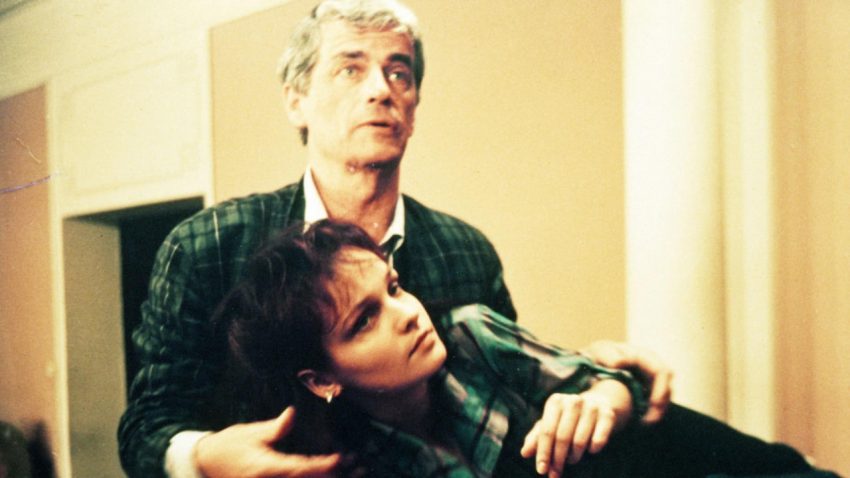
Episode four of Dekalog is very powerful, sensual, and, by general standards, decidedly transgressive. We are told a story about Michal and Anka, father and daughter. Anka is a spindly full-of-life eccentric. She twirls and hops, dreamy, always light on her feet. But she’s also gutsy when it comes to her craft, which is acting. In her restlessness the viewer can see seriousness and conviction.
In evident contrast, her father, Michał, is emotionally opaque and restrained. His aspect is stolid, and he gives off a strange radiance. (We are never told if ‘seeing the funny side’ was conferred on Anka from the late mother’s line). But that disparity in humours does not lead to empty exchanges. On the contrary, they fool around and laugh. We immediately know he loves her deeply.
Yet it wouldn’t be Kieślowski had it not been for subversion and confrontation. The morning antics—throwing water buckets at one another—are followed by clever foreshadowing. Michal has a flight scheduled. So he leaves her a letter. Its contents, however, strike us as most unusual so early in the plot. She discovers the letter shortly before they part. Written in a careful, compact cursive, it read: ‘Otworzyć po mojej śmierci’.
Vacillations ensue. To open or not. Change of location. The angelic figure (a recurring motif in Dekalog—could be conscience, could be guilt) deters her from doing so. But later Anka still confronts her father on this account. Drilling into his eyes, she recites the letter like a school poem: ‘Michał nie jest twoim ojcem’.
What follows is the punishment of retrospection. First, emotions well up. Anka feels betrayed.
They talk. He confesses he failed to muster up the courage to tell her the truth. Every point in time seemed wrong. At ten she seemed too young, at fifteen—too old. He made several half-hearted attempts to tell her ‘by accident’, dropping the letter here and there. This time, he left it on the table.
A mental pendulum keeps bouncing from familiarity to strangeness. Anka senses this acutely. The dramaturgy allows us to briefly inhabit her headspace. We see how Michał’s hands begin to feel both familiar and strange. He is equally a father and a stranger—an estranged father now.
But feeling betrayed as a daughter doesn’t mortify her for long—for there is a deeper, more disconcerting question (Freud would love this). It needs some time for the joke to register; but when it does, we immediately get that stroke of comedic genius. Imagine: it’s sexual.
The Oedipean complex that ascends to an utterly new, almost insurmountable ethical plane. But let us first list off how mental self-interrogation can possibly go—to unburden ourselves, as it were. Should he be condemned for desiring his daughter? Principally, what makes a father a father? Deeds? Biology? Filial connection? Which part of the dilemma (vulgarily) engrosses itself upon the fact that it feels wrong? The one where he’s the father? Or where he isn’t?
Let’s do some more. Are they allowed to give new shape to their relationship? Is it a matter of preference? Of habit? Of morals? The past gives him a hint—that he is still a father and that there is an ineradicable history they both share. Is it all now null and void? Or else, by desiring his daughter, what principle does he, strictly speaking, betray? What, was he bound to?
This being done, we see how lengthy our hesitation is. I think it testifies to the quality of the movie. All of a sudden, Kieślowski raises the stakes in a spectacular fashion. Tiptoeingly, Anka reciprocates the feeling. That she, too, wasn’t impartial to Michał. See, there is no way to go about it. If you shear off the past to explore the sexual relationship you plunge into sin. If you, however, leave the matter as it is you risk hatred and jealousy. We wonder, can we go beyond the confines of biology, affirming boundless human will?
Clearly, the picture is hospitably disposed to intensive questioning and cog-turning of the mind. One would guzzle the dilemmas, gourmand-like. Or mull over the ethical of the picture and all that. Yet we must not forget that it is, first of all, a picture. It is fitting, therefore, to consider the visual grammar.
Indeed, the conveyance of how shattered they were on the inside was executed in masterful simplicity. It took one neat strip of shadow across the face companioned by the reflected light to its opposite. Obvious, but effective. This same quality is, I am told, a throughline of many of his films. Not a formalist director, Kieślowski avoids explicitness—partly because it would be untoward to a subtler and more candid image of life, partly out of a Wittgensteinian concern that feelings and language rarely meet halfway.
True, we need not be reminded of it, less to be chaperoned to the meaning by means of visual cues. With directors of his stature, we labour under the assumption that the viewer is intelligent. But this tonality—the strong shadows, the chiaroscuro, if you will— is not preserved throughout. If anything, it is but a sign of heightened intensity—of deliberate, self-conscious theatricality.
Self-conscious, yes, but controlled too; it articulates extremities that escape simple form. It says: that’s life. That’s all there is to it.
Again, other sequences are markedly not like that1. They are defined by a warm or neutral palette and a very un-daring exposure. In Dekalogue, the vividness of the palette corresponds to heightened intensity. The rest of it, which is to say, most of it, has to be positioned within the mundane. It avoids tipping off-balance into inexcusable dramatism (which is tempting, when the story has much at stake).
In its balance, the mise-en-scene stays consistently and curiously Western. Contrary to some views, Kieślowski wasn’t engaged in vaudeville nor was he so keen on obfuscating the matter so it was cold and bold and dead. It wasn’t about being reprobate and morose. But his sensibility—one thing which betrays us, emigre writers, is sensibility—stays firmly Central-European, with its silent innuendos and grounded human solemnity. This, gladly, makes it possible to avoid the common mistake, to fall into the binary of fateful and fatal. And it does neither. It walks the tightrope steadily, with a confident face.
So much for visual concord. Kieślowski knows intimately all the ins and outs of film. When necessary, he implants the frame with sharp but lowkey tones to emphasise turmoil. When willed otherwise, he dispenses with art cinema, preferring milder, conventional hues. In both cases, the frame is meant to amplify the taut string of Eros which hangs between father and daughter. As relayed above, this is arranged with the idea of proper measure in mind. Background be background.
Kieślowski’s Dekalog is, what one might call, an attempt at definition. An instinct of a seafarer is to search for treasure i.e. for truth. Or something close to it. To probe the heretofore in its beginnings and learn, fastidiously, how it came to be and where it is now. Consider also this.
Kieślowski never individualises the theme. The problem must be enacted, yes, by means of characters and scenes; but he strictly refrains from stratifying these people by their faults. In the series, they all share the same leaden apartment complex somewhere in Warsaw. It could be far-fetched, but that deliberate choice strikes me as blunt: ‘The human condition pervades us all’.
To see it as banal is to grossly oversimplify, and it would mean that we learnt essentially nothing about Kieślowski’s intent. I believe the director never meant to exonerate our quizzical predicament. Nor to suggest that its irresoluteness precludes a meaningful fight. No, I believe he wants us to measure the human by human terms. He discerns the human essence and sees no answer key, no common logic by which he could haul out something conclusive. He probably asked, what if there is none? But for us, it wouldn’t make a difference. Human fault is there, it demands exploration. It forces us to look within ourselves. Answer or no answer, we must be accountable for the morals we created. In accountability, and only so, could we hope to keep it whole and still worth anything—anything at all.
§
In some online mag, I read the film’s brief which went: ‘…[Kieślowski] has all the discomforting compulsion of watching open-heart surgery.’ Extremely well put. What lingers solidly in our heads—after the allowance for wind is made, both for critics and piety alike—for the first to have their piece of fun, and for the second, to decide where it stands between ribald and obscene—is Kieślowski’s quest for truth.
For there is the truth and there is perspective. We seek the truth, we will it. Our rapturous, brittle-teethed intent snaps and growls as it tries to get to it, all in vain. Anka discards truth which, however alluring, brings intolerable pain. So it is with truth.
In this sense, the ending scene is declarative. They stand, holding the fire to the letter. Last reassuring looks. When it reached the charred edges, however, Anka could not resist a peek. To
half-confirm her worries, perhaps. But alas. Illegible. So neither of them arrives at the answer. If there was any hint, it burned with the letter. Momentarily, we shift our gaze to another character. We wonder, whom exactly Michal was waiting for? Was it a daughter or a lover?
Nothing yields satisfactory answers. Everything is irrelevant, in a finalising sense. But I would warn against it being a perspectival sign-off or a despondent ‘dust-to-dust’ cop-out. Kieślowski vests huge responsibility on his viewer, and asks for one awfully difficult thing. That, in acknowledgment of the fact that truth is elusive, to resist a simple diagnosis and leave the door slightly ajar.
Radomyr Lesnykov
1 I am aware that essays always suffer from myopia. They cannot possibly encompass everything; something they must exclude. But narrowing the scope also produces a wholesome effect. You manage to produce something original.
Photo: Dekalog IV press still, Jerusalem Cinematheque Israel Film Archive. Courtesy of: Telewizja Polska S.A